Casechek
Designing trust in healthcare payment automation.
Reimagining a manual, error-prone purchasing workflow into an intelligent payment automation experience for hospital enterprises.
Overview
Casechek is an enterprise healthcare platform that streamlines the Bill-Only purchasing workflow for patient-specific implants used in orthopedic, cardiovascular, and other complex surgical procedures. Unlike traditional purchasing, these implants are used during surgery before a purchase order exists, requiring hospitals to reconstruct each transaction from clinical documentation, vendor records, pricing data, and multiple enterprise systems before payment can be issued.
I led the end-to-end design of Bill-Only Automation with NoTouchPO™, transforming a fragmented, manual workflow into an intelligent payment automation experience. The platform validates every Bill-Only submission against multiple sources, including the hospital's Electronic Medical Record (EMR), Item Master, negotiated contract pricing, vendor-submitted bill data, and FDA device information, to determine whether a purchase order can be created automatically or requires human review.
The challenge wasn't simply automating purchase orders. It was designing a system that hospitals could trust. Clinical billing teams, supply chain, purchasing, and vendor representatives needed complete visibility into every validation, discrepancy, and decision before they were willing to rely on automation. Rather than replacing human judgment, the product automated routine transactions while surfacing only the exceptions that required investigation, creating a transparent workflow that reduced manual effort while preserving auditability and regulatory compliance.
Problem Space
Understanding the Bill-Only workflow.
A surgery happens before a purchase order exists. Hospitals must reconstruct what was used during surgery before they can purchase and pay for the implants.

Surgical Procedure
Vendor-supported procedure is completed.

Implant Usage
Vendor-owned implant is used during surgery.
Independent Documentation
Clinical and vendor teams document implant usage.
Vendor Bill Submission
Vendor submits implant usage and pricing details.
Hospital Review
Hospital validates implant usage, pricing, and documentation.
Purchase Order
Purchase Order (PO) is issued after validation.
Vendor Payment
Invoice is matched and payment is processed.
Why it matters
Because the purchase happens after the surgery, hospitals rely on accurate documentation and cross-functional coordination to reconstruct the transaction. Every handoff adds days to the purchase order cycle.
Business Challenge and User Pain Points.
Business Challenge
Healthcare organizations lose millions every year because implant purchasing happens after surgery, requiring multiple teams to manually reconstruct every transaction before a purchase order can be issued. The Bill-Only workflow wasn't broken in one place: it accumulated friction at every handoff. Fragmented documentation led to disconnected systems, which forced manual reconciliation, which delayed purchasing. Four systemic problems, each compounding the next. With 40+ U.S. health systems losing an average of $6.5M annually to documentation errors, the business case for automation was clear. The challenge was earning the trust to hand it off.
User Pain Points
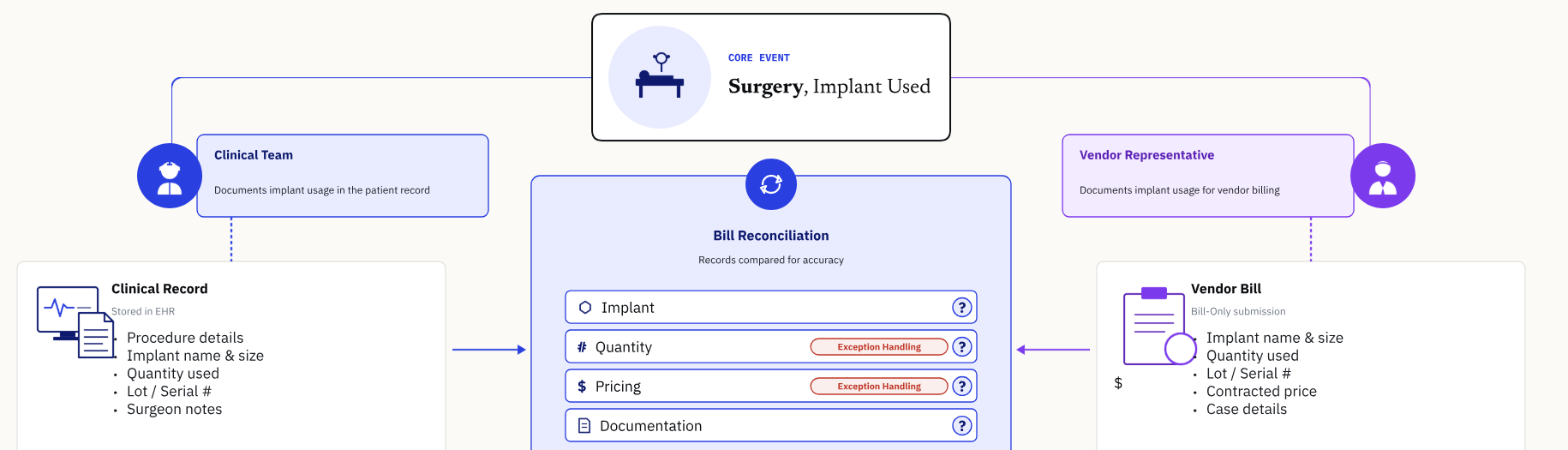
The moment an implant is used, two independent records are created by two different stakeholders: the clinical team documents usage in the patient's EHR, while the vendor representative submits a Bill-Only request with their own implant, quantity, and pricing data. These records are never automatically reconciled. Clinical billers had to manually compare them, identify discrepancies, and chase down vendor reps and circulating nurses to resolve conflicts, all before a purchase order could move forward. The average cycle ran 9 days across 5 departments, with no shared visibility into who was waiting on whom.
The Real Problem: The workflow wasn't broken in one place.
It accumulated friction at every handoff. Four systemic problems, each one compounding the next: from documentation, to systems, to reconciliation, to payment delay.

01
Fragmented documentation.
Critical information lives across clinical notes, vendor records, and supporting paperwork, often incomplete or inconsistent.
02
Disconnected systems.
Bill data is scattered across EHRs, ERPs, item masters, contracts, and vendor platforms with no single source of truth.

03
Manual reconciliation.
Pricing, quantities, and paperwork conflict. Every discrepancy pulls clinicians, supply chain, and vendors into manual work.
04
Delayed purchasing.
Approvals stall, admin overhead grows, and hospitals absorb the cost of documentation errors: millions in preventable loss.
Constraints
Every workflow touched HIPAA-protected patient data, FDA-regulated device records, and financial data subject to audit. Integration with legacy EHR and ERP systems was non-negotiable; hospitals could not replace their existing infrastructure. Billing teams trained to distrust automation in a regulated environment needed complete visibility into every validation step before they would hand off control. Vendor compliance was inconsistent: long-standing informal relationships between sales reps and surgeons created workarounds that any standardized process had to accommodate without breaking.
Designing in a Regulated Environment: Four constraints shaped every product decision.
Healthcare purchasing sits at the intersection of vendors, clinical, supply chain, financial, and regulatory systems. Automation had to earn trust inside those boundaries, not work around them.
01
Protected data & compliance.
Every workflow touched HIPAA-protected patient data, FDA-regulated medical device records, and financial data subject to audit.
02
Legacy healthcare systems.
Integration with existing EHR and ERP systems was mandatory; replacing hospital infrastructure was not an option.
03
Human trust & oversight.
Purchasing teams required complete visibility into every validation step before trusting automation in a highly regulated environment.
04
Vendor compliance.
Long-standing relationships between reps and surgeons created informal workflows that standardized processes had to accommodate without compromising compliance.
Impact
These constraints shaped every product decision, from workflow design and system integrations to explainable automation and exception handling.
Research
How we listened.
Key Insights
- 1Delays were systemic, not operational. The average 9-day PO cycle resulted from multiple departments waiting on one another, with no shared visibility into progress or ownership.
- 2Communication relied on people, not the system. Clinical billers had to compare independent clinical and vendor records, then chase down vendor reps and circulating nurses to determine the source of discrepancies before a PO could move forward.
- 3Automation without transparency wasn't trusted. Billing teams weren't looking for less control; they needed to understand every validation step before they could confidently rely on automated PO creation.
- 4Data quality issues originated upstream. Item Master pricing and product data were often outdated or incomplete, causing avoidable pricing discrepancies that surfaced only during bill reconciliation.
- 5Workflows encouraged inconsistent vendor compliance. Long-standing relationships between vendor reps and surgeons led to inconsistent documentation practices, making standardized compliance difficult to enforce.
Three steps where friction accumulates.
Surgical Procedure
Vendor-supported procedure is completed.
Implant Usage
Vendor-owned implant is used during surgery.
Independent Documentation
Clinical and vendor teams document implant usage.
Vendor Bill Submission
Vendor submits implant usage and pricing details.
Hospital Review
Hospital validates implant usage, pricing, and documentation.
Purchase Order
Purchase Order (PO) is issued after validation.
Vendor Payment
Invoice is matched and payment is processed.
The Moment Complexity Begins: Two records. One implant.
The moment an implant is used, two independent records are created: each serving a different purpose and maintained by a different stakeholder.
Strategy
Building on familiar mental models.
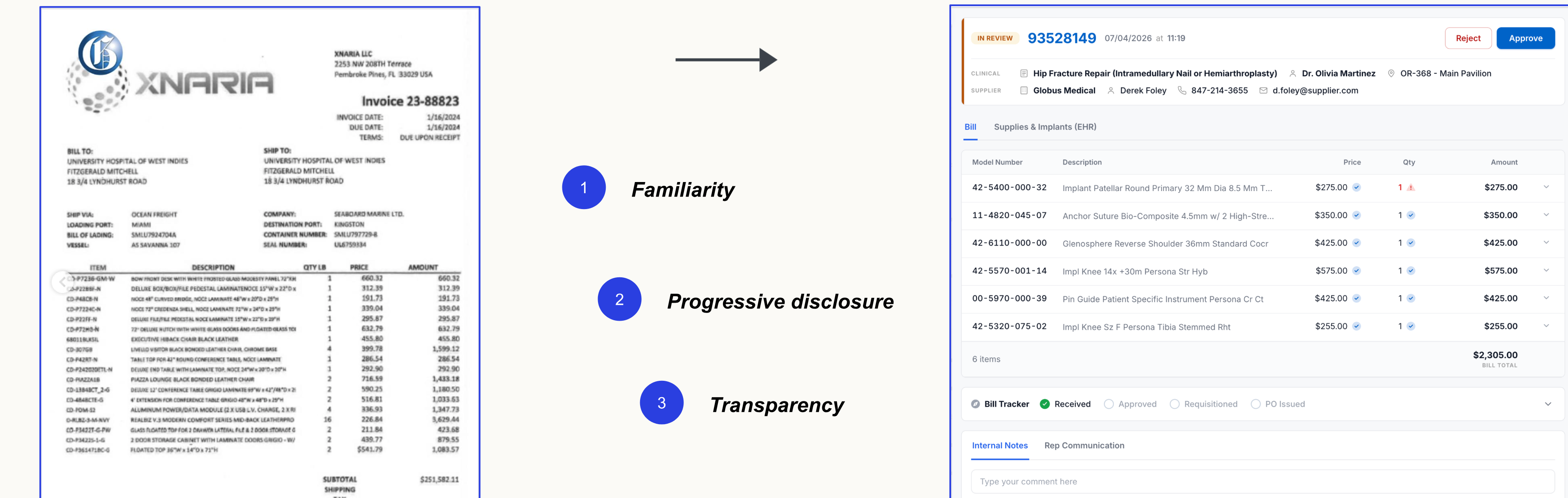
Reviewers already know invoices. We designed the digital experience to feel like one, then layered progressive disclosure and transparency on top. Rather than introducing a new paradigm, the interface anchored to something billing teams had used for years, reducing the learning curve and lowering the activation energy required to trust a new automated system.
Process
How we got there.
Discovery
Mapped the Bill-Only lifecycle across 5 health systems through contextual interviews, workflow shadowing, and stakeholder workshops. Built an end-to-end service blueprint that surfaced the systemic root causes of the 9-day PO cycle, revealing that delays weren't operational inefficiencies but the compounded result of disconnected documentation, systems, and people with no shared visibility.
Strategy
Synthesized research into a product strategy built on three principles: familiarity, progressive disclosure, and transparency. Defined the information architecture for a unified billing platform, identified 23 exception types requiring routing logic, and aligned executive stakeholders around a trust-first automation model, making the case that billing teams needed to see the system's decisions before they'd let the system make them.
Concept
Developed UX concepts for the billing queue, bill review interface, multi-source validation transparency layer, and shared Bill Tracker timeline. Explored progressive disclosure patterns that would let billing teams see what the system decided, without being overwhelmed by every underlying data source, and tested familiarity-anchored layouts that felt like reviewing an invoice rather than operating software.
Validation
Ran usability sessions with clinical billing teams, supply chain leads, and vendor representatives across multiple health systems. Iterated on exception routing, validation state design, and the Bill Tracker timeline until users reported confidence in the system's decisions and clarity about what required their attention, the threshold for trusting automation.
Execution
Designed and delivered all five platform surfaces: Dashboard, Bill Review, Timeline, NoTouchPO™ Automation, and Analytics. Built a reusable design system (shared status language, enterprise table and filter patterns, and transparent automation components) that reduced engineering effort and ensured consistency as the platform scaled across workflows and hospitals.
Rollout
Supported enterprise deployment across 40+ hospitals with in-product onboarding guidance and automation rate dashboards. Tracked NoTouchPO™ adoption week over week within the product itself, giving teams visible proof the system was working, building the confidence that drove adoption from partial to full touchless operation and an 82% reduction in manual processing effort.
Solution
What we built.
Four design decisions shaped every surface of the product, and five interconnected surfaces made them real. Together they transformed a fragmented, manual workflow into an intelligent payment automation experience built on transparency, familiarity, and shared accountability.
Design Decisions
Four decisions that shaped the experience.
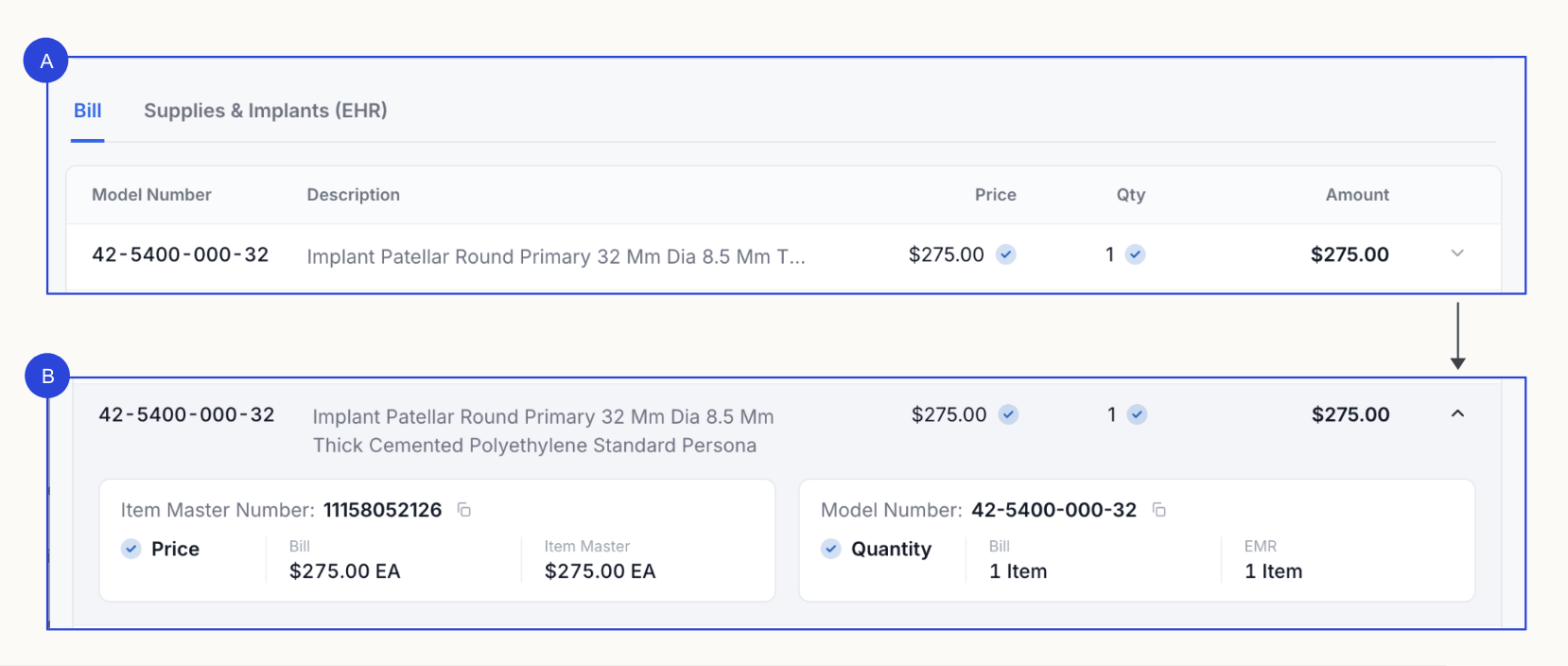
Progressive disclosure.
Decision
Show the answer first. Reveal detail on demand.
Why
Users needed confidence before detail.
Impact
Reduced cognitive load.
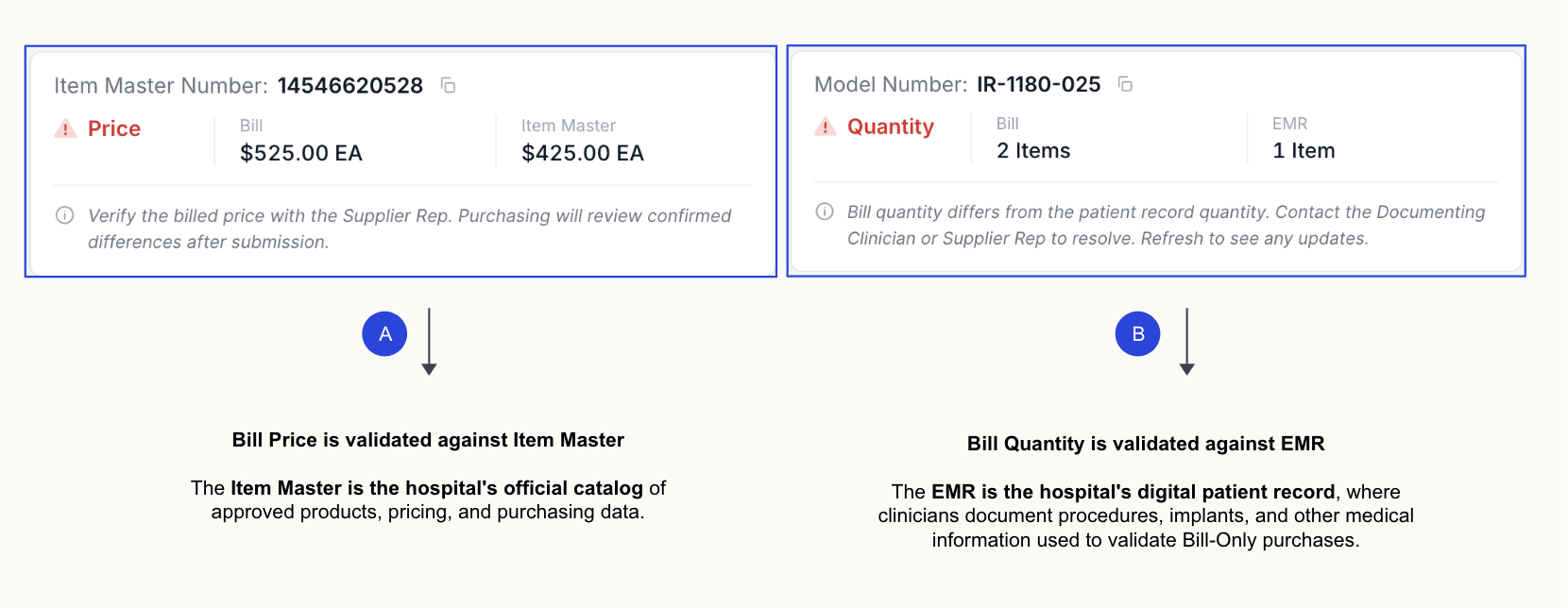
Transparent validation.
Decision
Every validated field explains its source and status.
Why
Automation must explain itself.
Impact
Increased trust.
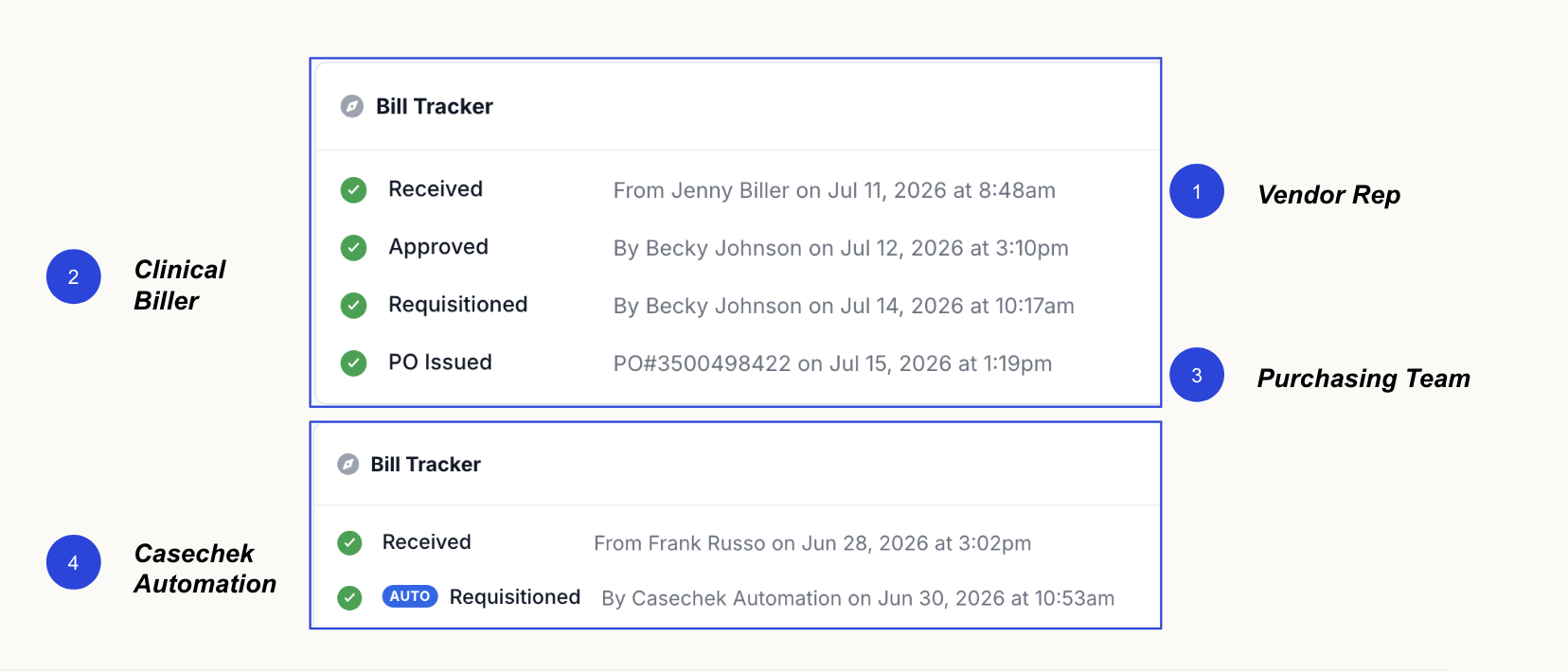
Shared timeline.
Decision
Every action, system or human, lives on one shared timeline.
Why
Every action needed to be visible.
Impact
Shared accountability.
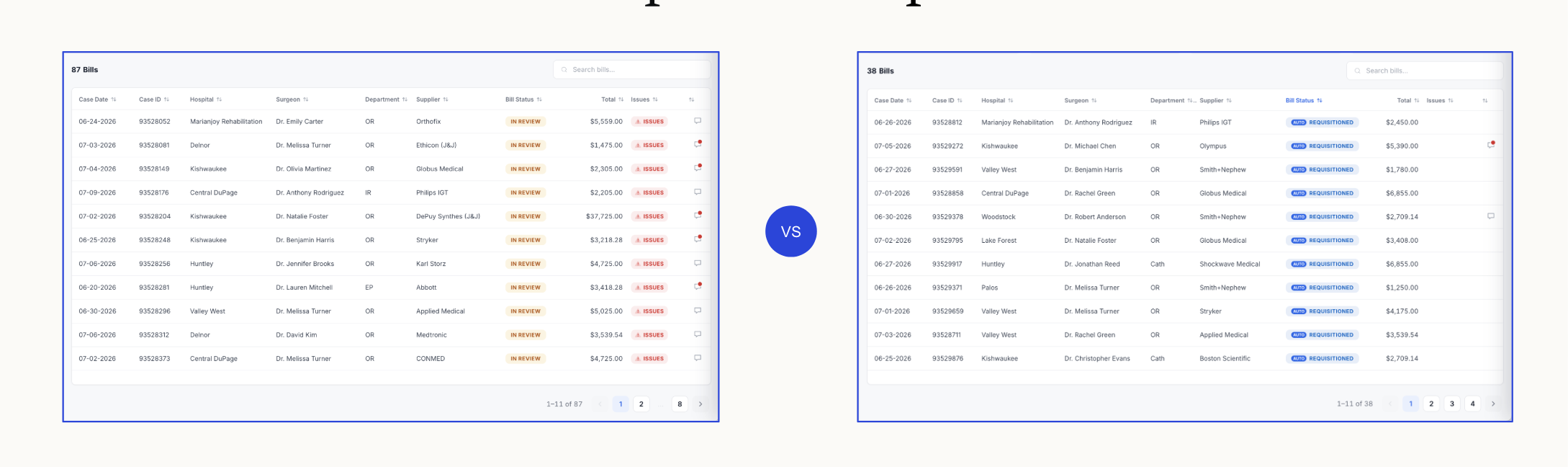
Exception-first workflow.
Decision
Surface only bills requiring human judgment.
Why
Humans review only uncertainty.
Impact
Automation absorbs routine work.
Bringing it together
One shell. Five surfaces.
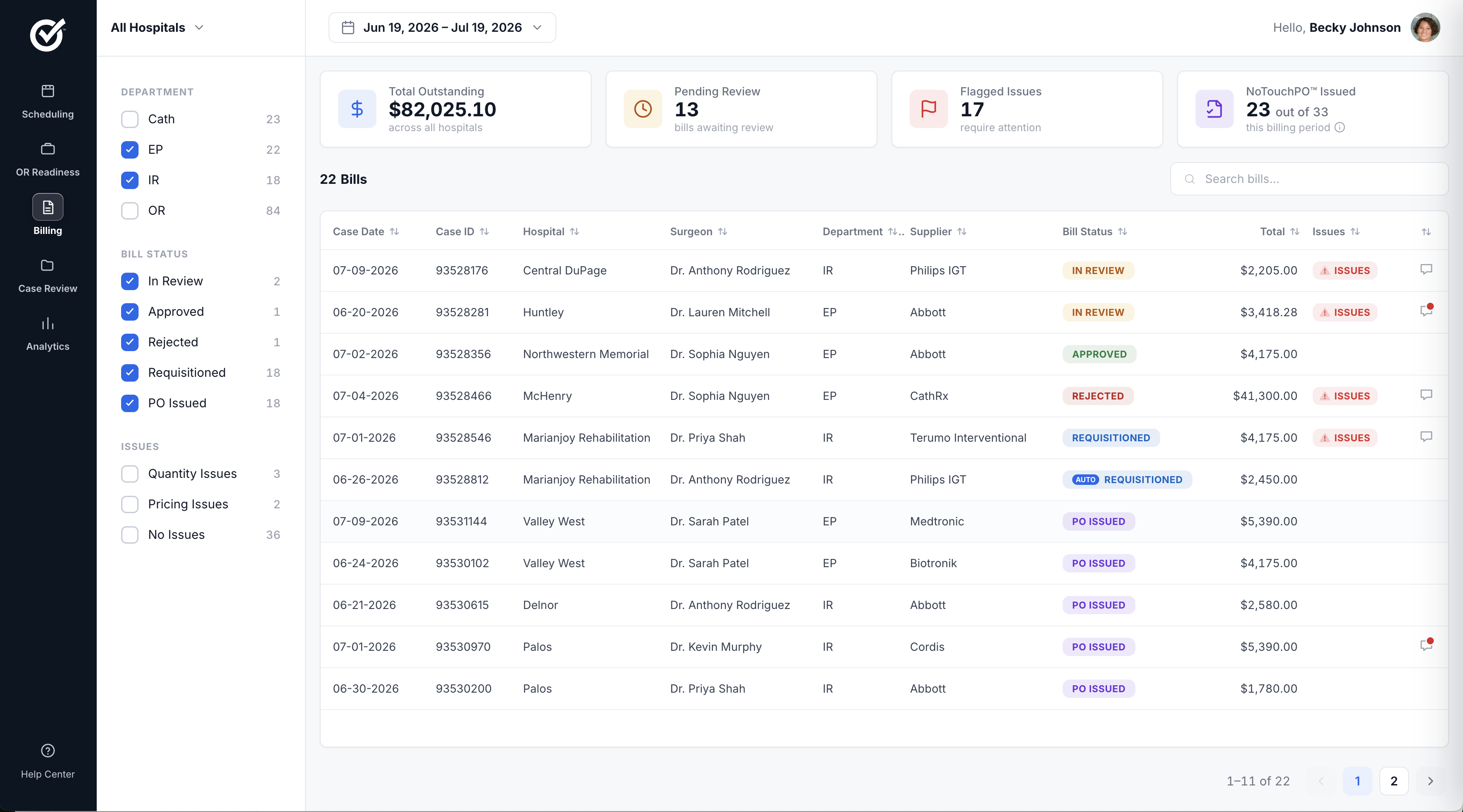
The Dashboard is the operational home. Bill Review, Timeline, Automation, and Analytics extend from it, each a distinct surface of the same shared model.
Dashboard
Operational health across every bill: total outstanding, pending review, flagged issues, and NoTouchPO™ automation rate at a glance.
Bill Review
Focus only on bills requiring judgment. In Review, Approved, and Rejected, surfacing only the exceptions that need a human decision.
Timeline
Every action, system or human, in one place. The Bill Tracker is the shared operational timeline that replaced fragmented email and phone chains.
Automation
Validated bills flow to PO automatically. NoTouchPO™ absorbs routine work, issuing purchase orders in minutes without human intervention.
Analytics
Trends, throughput, and exception rates over time. The foundation for operational intelligence and cross-hospital benchmarking.
Experience the Prototype
Experience Bill-Only Automation with NoTouchPO™.
This case study highlighted the strategy, research, and key design decisions behind Bill-Only Automation with NoTouchPO™. Explore the interactive prototype to experience the complete enterprise workflow firsthand.
Prototype Highlights
- 01End-to-end Bill-Only workflow
- 02Validation Engine
- 03Exception Handling
- 04Bill Tracker
- 05Billing Dashboard
Launch the Prototype
Password Protected
Impact
Business outcomes across the enterprise.
Less manual work. Automation absorbs routine bill processing across 40+ enterprise health systems, cutting manual reconciliation from 17,000+ hours to under 3,000 annually.
PO turnaround time. Reviewers act on validated data with clear next steps. No more reconstructing bills across systems or chasing discrepancies by phone.
Average annual documentation loss per hospital identified. The shared data model becomes the substrate for adaptive thresholds, benchmarking, and AI recommendations.
Higher confidence.
Reviewers act on validated data with clear next steps. No more reconstructing bills across systems or chasing discrepancies by phone.
Reusable patterns.
Every new workflow ships from shared components, less bespoke code, faster delivery across the enterprise.
Foundation for intelligent automation.
The shared model becomes the substrate for adaptive thresholds, benchmarking, and AI recommendations.
“I can see exactly which field failed and why. That's what made me trust it. Before, automation felt like a black box. Now I know what it checked and where the discrepancy came from.
Reflection
What I learned.
The most important thing I learned designing NoTouchPO™ is that the hardest part of automation isn't the automation. It's the trust. Billing teams didn't need a smarter system. They needed a system they could see into. Every design decision that increased transparency (the validation breakdown, the Bill Tracker timeline, the exception routing with source context) moved hospitals faster toward full adoption than any performance improvement. If I were to take this further: instrument every workflow to turn operational health into a real-time signal rather than a monthly report; move from validation to suggestion by recommending likely resolutions for common exception patterns; and build cross-hospital benchmarking to surface bottlenecks before they compound across the network. The closing lesson: great enterprise products aren't defined by automation. They're defined by the trust required to automate.